How to Hide an Empire
Daniel Immerwahr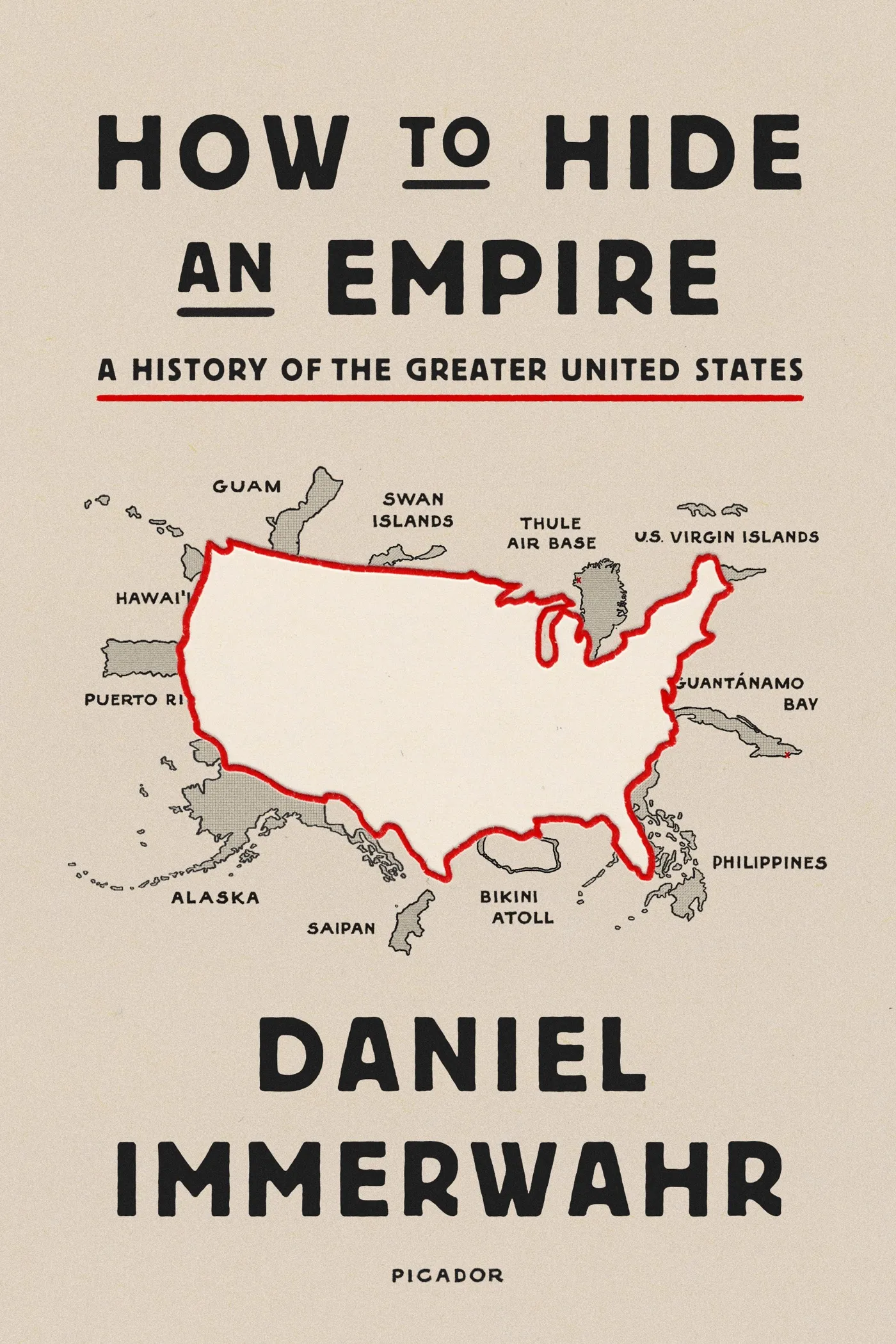
My 68 highlights
-
Within a week of fighting, U.S. shelling of the whole area in front of advancing troops became, as one report put it, “the rule rather than the exception.” Any structure suspected of containing Japanese troops was a target. “Block after bloody block was slowly mashed into an unrecognizable pulp,” recorded the 37th’s official history. That included refugee centers, such as the Philippine General Hospital (a Parsons-built landmark), where a few Japanese soldiers were holed up—and more than seven thousand civilians. The 37th fired at the hospital for two days and nights. These were “days of terror,” remembered a Filipino trapped inside. “I can still hear the screams of the wounded clearly to this day.” Other refugee shelters—the Remedios Hospital, the Concordia Convent—met similar fates.
-
What getting the Greater United States in view reveals is that race has been even more central to U.S. history than is usually supposed. It hasn’t just been about black and white, but about Filipino, Hawaiian, Samoan, and Chamoru (from Guam), too, among other identities. Race has not only shaped lives, it’s shaped the country itself—where the borders went, who has counted as “American.” Once you look beyond the logo map, you see a whole new set of struggles over what it means to inhabit the United States.
-
The defeated powers’ colonies, instead of being liberated, were redistributed among the victors. The only novelty was that they were now classified as “mandates” under the League of Nations (this was Smuts’s proposal). The mandates were arranged in a transparently racial hierarchy, with Middle Eastern territories on top (“Class A,” en route to independence) and African and Pacific Island territories below (“Classes B and C”).
-
Without the representative government that Western Territory would have provided, Indian Country was, from the perspective of Washington, less a colony than a holding pen.
-
Although Navassa didn’t have much actual guano, its coral reef was packed with deposits of tricalcium phosphate, the fossilized legacy of centuries’ worth of marine life—also a rich nutrient for exhausted soil. Under the control of the Navassa Phosphate Company, this would prove to be the most reliable source of fertilizer in the United States’ budding island empire.
-
He was the first president to set foot in South America, Africa, or Asia while in office.
-
Nationalism in Puerto Rico was “about as lunatic a movement as could exist in the world,” wrote The New York Times.
-
The bill passed, and speculators scrambled to stake their claims. It was another land rush, this time in the Pacific and the Caribbean. The first batch of islands were added to the United States in 1857. By 1863, the government had annexed fifty-nine islands. By the time the last claim was filed, in 1902, the United States’ oceanic empire encompassed ninety-four guano islands. “The Pacific will be ours, and the Atlantic mainly ours,” crowed Walt Whitman. “What an age! What a land!”
-
In the venerable U.S. tradition of naming places for the people who have been driven from them, the newly opened territory was called Oklahoma, a Choctaw word meaning “red people.”
-
Franklin Delano Roosevelt established a central office in 1934: the Division of Territories and Island Possessions within the Interior Department. For the first time, Puerto Rico, Alaska, Hawai‘i, and the U.S. Virgin Islands were under a single authority, and within five years it would cover the Philippines and the major guano islands, too. The only inhabited territories remaining separate were Guam and American Samoa, kept as fiefdoms of the navy.
-
The fantasy of conquest is always the same: defeat the leader and the country is yours. The United States had learned the folly of this when it won the Philippines from Spain, only to find itself fighting the Philippine Army. It was about to learn the lesson again.
-
In a single stroke, Haber had opened the floodgates for the virtually unlimited growth of human life. The Malthusian logic was repealed. Soil exhaustion ceased to be an existential threat; you could just add more chemicals. Without Haber–Bosch, the earth could sustain, at present rates of consumption, only about 2.4 billion people.
-
In late 1945, counting the occupations, 51 percent of the population of the Greater United States lived outside the states. But by 1960, after Hawai‘i and Alaska entered the union, that number had fallen to around 2 percent, which is roughly where it has been ever since.
-
He may have been a maladroit politician and a poor steward of the economy, but Hoover was an astonishingly capable bureaucrat. And there was little he cared about as much as standardization. Herbert Hoover, as a man, can best be understood as the opposite of Teddy Roosevelt. Whereas Roosevelt lusted for combat and styled himself as a cowboy, Hoover was a Quaker who had lived for a year among Osages in Indian Country (he later had Charles Curtis, a Native American with Osage heritage, as his vice president).
-
During the war, during the congressional debates over the treaty with Spain, and during the heated election of 1900, the question of empire was argued at high volume. In essence, it was an argument about a trilemma. Republicanism, white supremacy, and overseas expansion—the country could have at most two. In the past, republicanism and white supremacy had been jointly maintained by carefully shaping the country’s borders. But absorbing populous nonwhite colonies would wreck all that.
-
The “better to lose a building than an American life” logic succeeded in protecting mainland soldiers. In the month of fighting, 1,010 of them died. Compare that with the 16,665 Japanese troops who perished. And compare that with the 100,000 Manilans killed. For every “American life” lost, 100 Manilans died.
-
Natural rubber, coming mainly from Indonesia, Thailand, and Malaysia, still makes up about 30 percent of the market. Yet it’s no longer a vital necessity, the sort worth conquering territory to secure. When the supply drops, synthetic rubber plants make up the difference with ease.
-
Plastic is a chemical cousin of synthetic rubber—the ontological line between them can get blurry. Their histories are similar, too, though unlike synthetic rubber, plastic had notable successes well before the Second World War.
-
It wasn’t until 1927 that traffic lights were standardized. Before that, drivers in Manhattan stopped on green, started on yellow, and understood red to mean “caution.” A different system prevailed in Cleveland, a different one in Chicago, a different one in Buffalo, and so on
-
In the West Coast camps, the death rate of internees was no greater than that of normal civilians. But in Alaskan camps, by the war’s end, 10 percent had died.
-
Combine a republican commitment to equality with an accompanying commitment to white supremacy, and this is what you got: a rapidly expanding empire of settlers that fed on land but avoided incorporating people. Uninhabited guano islands—those were fine. But all of Mexico or Nicaragua? No.
-
Empire might be hard to make out from the mainland, but from the sites of colonial rule themselves, it’s impossible to miss.
-
To accept Hawaiian and Alaskan statehood, mainland politicians would have to reconcile themselves to the prospect of states not firmly under white control.
-
The war is usually called the Spanish-American War and is said to have started in 1898. Yet a more accurate name would be the Spanish–Cuban–Puerto Rican–Philippine–American War. Cubans call it the War of 1895, Filipinos date its start at 1896—and neither of those counts the many earlier uprisings and wars. The United States was, in other words, a latecomer, supplying a burst of force at the end of a long, bloody conflict that had already nearly destroyed the Spanish Empire.
-
Workers who fell ill were fined. Those who made trouble were “triced”: tied up for hours in the hot sun with their arms in the air and their feet barely touching the ground.
-
Today, around four million people live in those unincorporated territories—people who have no representation in Congress, who cannot vote for president, and whose rights and citizenship remain a gift from Washington. They could seek statehood, as indeed a large number in Puerto Rico would like to do. But statehood is, like so many other things, at the sole discretion of Congress—a legislative body in which neither Puerto Ricans nor other colonial subjects have a vote.
-
The tens of thousands of defendants who passed through Hawai‘i’s provost courts were not charged with the usual: robbery, assault, fraud, etc. They were tried for failing to show up to work, for breaking curfew, and for committing traffic violations, mainly.
-
The imperialists offered a different solution to the trilemma. They were willing to sacrifice republicanism, at least as applied to so-called backward races. Roosevelt scorned those “who cant about ‘liberty’ and the ‘consent of the governed,’ in order to excuse themselves for their unwillingness to play the part of men.” He continued: “Their doctrines, if carried out, would make it incumbent upon us to leave the Apaches of Arizona to work out their own salvation, and to decline to interfere in a single Indian reservation. Their doctrines condemn your forefathers and mine for ever having settled in these United States.”
-
The culture changed, too. Rather than being despised “banditti” or “white savages” on the fringes of civilization, settlers acquired a new identity: pioneers. No longer scofflaws, they were the proud flag-bearers of a dynamic nation.
-
During the Second World War, the United States honed an extraordinary suite of technologies that gave it many of the benefits of empire without having to actually hold colonies. Plastics and other synthetics allowed it to replace tropical products with man-made substitutes. Airplanes, radio, and DDT enabled it to move its goods, ideas, and people into foreign countries easily without annexing them. Similarly, the United States managed to standardize many of its objects and practices—from screw threads to road signs to the English language—across political borders, again gaining influence in places it didn’t control. Collectively, these technologies weaned the United States off the familiar model of formal empire. They replaced colonization with globalization.
-
Simply put, World War II made the United States a planetary presence.
-
What happened in North Africa and the Middle East happened all over the world. You can think of the U.S. mainland during the Second World War as a giant heart pumping out rich streams of matériel. Strings of bases functioned as arteries, carrying it to the battlefronts. The bases were where planes landed and ships docked, where spare parts, fuel, and food were stored, where wounded men and damaged things were repaired.
-
One of the truly distinctive features of the United States’ empire is how persistently ignored it has been.
-
A Republican congressman who toured Luzon in 1902 reported what he saw to a newspaper. “The country was marched over and cleaned in a most resolute manner,” he said. “Our soldiers took no prisoners, they kept no records; they simply swept the country, and wherever or whenever they could get hold of a Filipino they killed him.”
-
Looking back on the years before 1898, one sees a pattern. Though the United States had rapidly annexed new territory, it had rarely incorporated large nonwhite populations. Louisiana, Florida, Oregon, Texas, and the Mexican cessions—these added a lot of area to the country but only relatively small “foreign” populations
-
Get the good old syringe boys and fill it to the brim We’ve caught another nigger and we’ll operate on him Let someone take the handle who can work it with a vim Shouting the battle cry of freedom
-
A few years after the moon landing, NASA convened a study group on space colonization, which judged it to be both “technically feasible” and “desirable.”
-
With encouragement from the authorities, civilians hunted for any Japanese who remained hidden. Filipinos who helped hide them were arrested. Japanese women were raped, by both civilians and soldiers, and Japanese homes and businesses were ransacked. In Manila, the police parked trucks containing more than a hundred internees in the middle of the street during an air raid, a tempting target for Japan’s bombers and a terrifying ordeal for those trapped inside. In Davao, guards repeatedly vented their rage against Japan by arbitrarily shooting prisoners—one internee estimated that they killed fifty in all.
-
The frontier skirmishes such men started were rough business, Roosevelt conceded, “peculiarly revolting and barbarous.” But they were necessary. “The most ultimately righteous of all wars is a war with savages, though it is apt to be also the most terrible and inhuman,” he wrote. “The rude, fierce settler who drives the savage from the land lays all civilized mankind under a debt to him.”
-
Squatters who rushed over the mountains were impossible to govern, and the wars they inevitably started were expensive to fight. Washington thus insisted that settlement proceed in a “compact” manner, under elite control. That way, the frontier would be not a refuge for masterless men like Boone but the forefront of the march of civilization, advancing at a stately pace. To realize their vision, the founders created a distinct political category for the frontier: territory.
-
When World War I erupted, Haber volunteered his services. He suggested that the ammonia now pouring out of German fertilizer plants could be repurposed as explosives to bolster Germany’s dwindling munitions supplies.
-
Dozens of university laboratories screened more than fourteen thousand compounds in search of a synthetic antimalarial. Prisoners and conscientious objectors were brought in as guinea pigs.
-
From the day the treaty securing independence from Britain was ratified, right up to the present, it’s been a collection of states and territories. It’s been a partitioned country, divided into two sections, with different laws applying in each.
-
Alaska Natives endured a harsh Jim Crow system: separate seating in theaters, segregated schools, and NO NATIVES ALLOWED signs on hotels and restaurants.
-
In 1845 the United States Magazine and Democratic Review coined an indelible phrase and captured the prevailing mood when it wrote of the nation’s “manifest destiny to overspread the continent allotted by Providence for the free development of our yearly multiplying millions.”
-
Tires, tubes, hoses, insulation for electrical wires, raincoats, life rafts, gas masks, and a thousand little parts and bits were made from it. Between 1860 and 1920, world rubber consumption grew nearly two-hundred-fold.
-
Nor did Haber stop there. He assembled a supergroup of German scientists, four of whom, like he, would go on to win Nobel Prizes. Overseeing their efforts, he introduced his second great invention: poison gas.
-
party politics, the two territories were balanced, it being widely assumed that Hawai‘i would be a Republican state and Alaska a Democratic one (exactly wrong, it turned out). But their admission would quite obviously unbalance national politics on another axis. Whatever the party allegiances of these new states, their racial composition would put them firmly in the civil rights camp. Southern Democrats in the Senate, nervous about what these states would do to Jim Crow, threatened to filibuster.
-
The former president of Columbia University and Nobel laureate Nicholas Murray Butler warned that admitting Hawai‘i and Alaska to the union would “mark the beginning of the end of the United States as we have known it.”
-
This was the legacy of the Second World War. Take the world’s most advanced economy, cut it off from most tropical trade, and send it into overdrive—it was the perfect recipe for a synthetic revolution.
-
For more than thirty years the Cuban constitution contained an astonishing clause granting the United States the right to invade Cuba (which it did, four times).
-
The more that countries industrialized, the more they depended on the produce of distant locales. They found themselves needing rubber from Southeast Asia, jute from India (for packaging), palm oil from West Africa (an industrial lubricant), tungsten from Korea (for lightbulb filaments), and copper from South America. At times, the Industrial Revolution could look like a worldwide scavenger hunt for obscure tropical products.
-
Months before Pearl Harbor, the Philippine Assembly had passed a bill requiring foreign nationals to register with the government and have their fingerprints taken. Then, on the day of the attack, MacArthur ordered police to round up the Japanese population, including naturalized Philippine citizens and people of Japanese ancestry born in the Philippines.
-
By the end of the war, the government had built fifty-one synthetic rubber plants (compared with Germany’s three), operating at the collective cost of $2 million a day. Just one such plant, which might employ 1,250 workers, made enough rubber to replace a rubber plantation that had twenty-four million trees and a workforce of at least 90,000. In mid-1944 the supply of rubber met the government’s requirements. By 1945, it overshot them.
-
Sondheim cut those verses but left in a portrait of island life, offered in the song “America,” that managed to capture nearly every stereotype about Puerto Rico. Puerto Rico was, in the song, an “ugly island” of “tropic diseases,” with “hurricanes blowing” and its “population growing.” Before West Side Story premiered, the editors of La Prensa, a Puerto Rican paper in New York, called the show’s producers to object to the portrayal of Puerto Rico as disease-ridden. They threatened to picket if the song wasn’t altered. Sondheim conceded, later, that their complaint was justified. But he changed nothing.
-
The United States took advantage of its position—as the undisputed economic and political superpower, with its wartime logistical network installed in more than a hundred countries—to push its standards beyond its borders. The wave of U.S.-centered standardization that followed transcended the scale of the nation or the empire. This was standardization at the scale of the planet.
-
Colonialism imprints foreign names on people and places. What to call the locales and populations that have come under it can thus be a politically charged question.
-
At least, the government was comfortable taking the men of the Pribilof Islands back to their homes to work the 1943 seal harvest (the Fish and Wildlife Service had a lucrative deal with a fur company). But once the Pribilovians turned over the furs, they were sent straight back to the camps.
-
The Mexican War of 1846–48 had ended with U.S. forces occupying Mexico City. Some in Congress proposed taking all of Mexico. From a military perspective, that was entirely feasible. But South Carolina senator John C. Calhoun, one of the nation’s prime defenders of slavery, objected. “We have never dreamt of incorporating into the Union any but the Caucasian race—the free white race,” he insisted on the Senate floor. “Are we to associate with ourselves, as equals, companions, and fellow-citizens, the Indians and mixed races of Mexico?” Apparently not. The United States annexed the thinly populated northern part of Mexico (including present-day California, Utah, New Mexico, and Arizona) but let the populous southern part go. This carefully drawn border gave the United States, as one newspaper put it, “all the territory of value that we can get without taking the people.”
-
you looked up at the end of 1945 and saw a U.S. flag overhead, odds are that you weren’t seeing it because you lived in a state. You were more likely colonized or living in occupied territory. Probably somewhere in the Pacific.
-
Beriberi, it should be noted, is an extremely hard disease to contract. To get it as an adult, you have to eat a profoundly restricted diet, such as milled rice and virtually nothing else, for months. But Filipinos, separated from their farms and able to purchase only the cheapest food, suffered from it in large numbers, probably in the tens of thousands. It struck babies the hardest. Although infantile beriberi was unknown to doctors at the time (thus unrecorded as a diagnosis), it is doubtless the reason why Manila during the war had the world’s highest recorded infant mortality rate.
-
As the Spanish governor-general explained, he was “willing to surrender to white people but never to Niggers.” Filipinos who had besieged Manila for two and a half months, at the cost of thousands of lives, thus watched in astonishment as their allies entered the city unopposed, locked Filipino soldiers out, and fraternized with the enemy. One minute after the Spanish flag came down over Manila, an enormous U.S. flag climbed the flagpole in its place. The band struck up “The Star-Spangled Banner.”
-
The ability of empires to promulgate standards was a major benefit of colonial conquest. Imperial standardization meant that even in faraway lands, the colonizers’ practices would be adhered to
-
the United States maintains roughly eight hundred overseas military bases around the world.
-
During the war, the military devised a suite of logistical innovations, all designed to move people, things, and information cleanly and quickly around the planet. Planes were the most obvious—the United States came to dominate aviation—but others were no less important. Radio, cryptography, dehydrated food, penicillin, and DDT: these technologies laid the foundations of today’s globalization.
-
“The word colony must not be used to express the relationship which exists between our government and its dependent peoples,” an official admonished in 1914. Better to stick with a gentler term, used for them all: territories.
-
Although the country’s official name has always been the United States of America, in the nineteenth century it was common to call it the United States, or perhaps refer to it by its political structure: the Republic or the Union. Though inhabitants of the country were often called Americans, it is striking how infrequently America was used.
-
Synthetics diminished the great powers’ need for strategic raw materials by offering substitutes. Aviation, cryptography, radio, and satellites, meanwhile, enabled those powers to run secure transportation and communication networks without worrying about contiguous territorial access. Innovations in medicine and engineering—such as DDT, antimalarials, plastic-based packaging, and “world-proofed” electronic equipment—further reduced the need for territorial control. They allowed objects and humans to safely travel to hostile terrains, meaning that colonizers didn’t have to soften the ground beforehand.