Braiding Sweetgrass
Robin Wall Kimmerer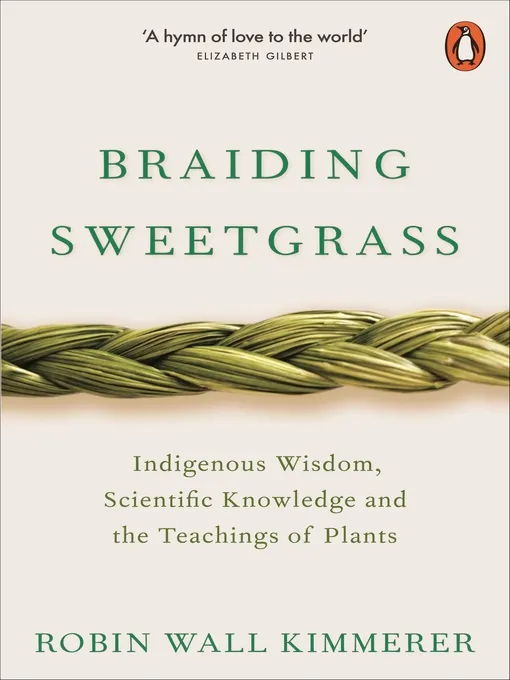
My 8 highlights
-
Living by the precepts of the Honorable Harvest—to take only what is given, to use it well, to be grateful for the gift, and to reciprocate the gift—is easy in a pecan grove. We reciprocate the gift by taking care of the grove, protecting it from harm, planting seeds so that new groves will shade the prairie and feed the squirrels.
-
Throughout Indian Territory there are records of Indian agents being paid a bounty for rounding up kids to ship to the government boarding schools. Later, in a pretense of choice, the parents had to sign papers to let their children go “legally.” Parents who refused could go to jail.
-
As a gift-thinker, I would be deeply offended if I saw wild strawberries in the grocery store. I would want to kidnap them all. They were not meant to be sold, only to be given
-
How, in our modern world, can we find our way to understand the earth as a gift again, to make our relations with the world sacred again? I know we cannot all become hunter-gatherers—the living world could not bear our weight—but even in a market economy, can we behave “as if ” the living world were a gift?
-
The more something is shared, the greater its value becomes. This is hard to grasp for societies steeped in notions of private property, where others are, by definition, excluded from sharing. Practices such as posting land against trespass, for example, are expected and accepted in a property economy but are unacceptable in an economy where land is seen as a gift to all.
-
the nine bands of Potawatomi, scattered across the country by this history of removal, come together again for a few days each year in a search for belonging. The Potawatomi Gathering of Nations reunites the people, an antidote to the divide-andconquer strategy that was used to separate our people from each other and from our homelands.
-
From the viewpoint of a private property economy, the “gift” is deemed to be “free” because we obtain it free of charge, at no cost. But in the gift economy, gifts are not free. The essence of the gift is that it creates a set of relationships. The currency of a gift economy is, at its root, reciprocity. In Western thinking, private land is understood to be a “bundle of rights,” whereas in a gift economy property has a “bundle of responsibilities” attached.
-
It was through her actions of reciprocity, the give and take with the land, that the original immigrant became indigenous. For all of us, becoming indigenous to a place means living as if your children’s future mattered, to take care of the land as if our lives, both material and spiritual, depended on it.