Wisdom Eccentrics
Ngakpa Chögyam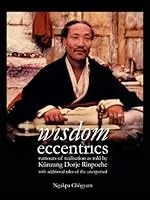
My 12 highlights
-
“The most important thing with Dzogchen is presence of awareness. There are all kinds of obstacles to presence of awareness. The first is the obstacle of laziness and the second is forgetfulness. Even having received pointing-out instruction – we tend to forget. The third obstacle is depression. Depression means blocking thought – the state where thought no longer arises. In this state, it is not possible to identify experiences. This state is one of total blankness. Another form of depression is agitation – when concepts move too quickly. If you see a person like this, they may appear to be sitting perfectly – but internally, they’re exhausted by travelling everywhere at once. “As to how we should meditate – it’s important to break sitting into short sessions. Meditation doesn’t require sitting for long stretches – as if there were value merely in not moving. It’s better to meditate for short periods – rather than long sessions that have no result. When drops of water accumulate they gather momentum – but each drop is separate. Each drop is unique. Meditation sessions should accumulate in the same way. “There should be no obsession with presence of awareness – as this merely leads to saturating mind with concepts about presence of awareness. The opposite is as bad – paying no heed to presence of awareness and letting your attention blow like litter in an Indian town. “Don’t indulge in sensitivity …” Rinpoche concluded “… or allow yourselves to be assaulted by the weapon of emotions. If you become a victim of your own emotions … meditation is meaningless.”
-
“I see the greatest wealth as being the extent to which I can appreciate everything within the sense fields.
-
“Blessing is the recognition of the nature of Mind. We all have beginningless nondual nature, and when we see that—that—is blessing!”
-
“Do not make—anything—in your life a matter of regret. Regret means you have acted without awareness! Keep your awareness and you will—never—have to regret anything. Keep your awareness and you will not become ’thom yor again. If you doubt your awareness then simply be kind. Be like your mother.”
-
“The ocean is not defined by waves” he stated, pointing at the sea. “Waves, you can study forever – but you will find no definition of ocean there …” [pause] “Waves arise in the ocean. They are limitless like thoughts in Mind …” [pause] “If you don’t try to define ocean by studying waves – you will see waves and ocean are indivisible.”
-
“Rigpa—realisation—is not always present
-
This oral tradition is gloriously open to human process. It suggests history as being whatever it needs to be at any one time in order to be of real value to people.
-
“… every sound is mantra … every movement is mudra … every act is empowerment … every moment is transmission …”
-
The alternative to belief does not have to be active disbelief. In terms of Buddhism – you either know or you don’t know. If you’ve practised enough, you will know what holds true in your own experience – and will therefore have no need of belief or disbelief.
-
“You can’t—always—know what will happen. Mostly you have to go into emptiness and simply see what happens” Rinpoche chuckled “You will have to do this – so many times!”
-
“You told me you wrote poetry?” I replied in the affirmative and Rinpoche nodded. “Yah—good. To explain Vajrayana it is necessary. Vajrayana is not ordinary and so ordinary language cannot be used. Vajrayana is the poetry of existence beyond space and time
-
“We only classify the world for certain reasons. For example, plants can be food or medicine and we need to know what is poisonous – but the sense-making frameworks we build are no more than that. They don’t really describe what we see or hear – they simply give us a means of controlling them according to what we think we want …” [pause] “… then we have all kinds of ideas and prejudices based on how we label everything.”