Against the Loveless World
Susan Abulhawa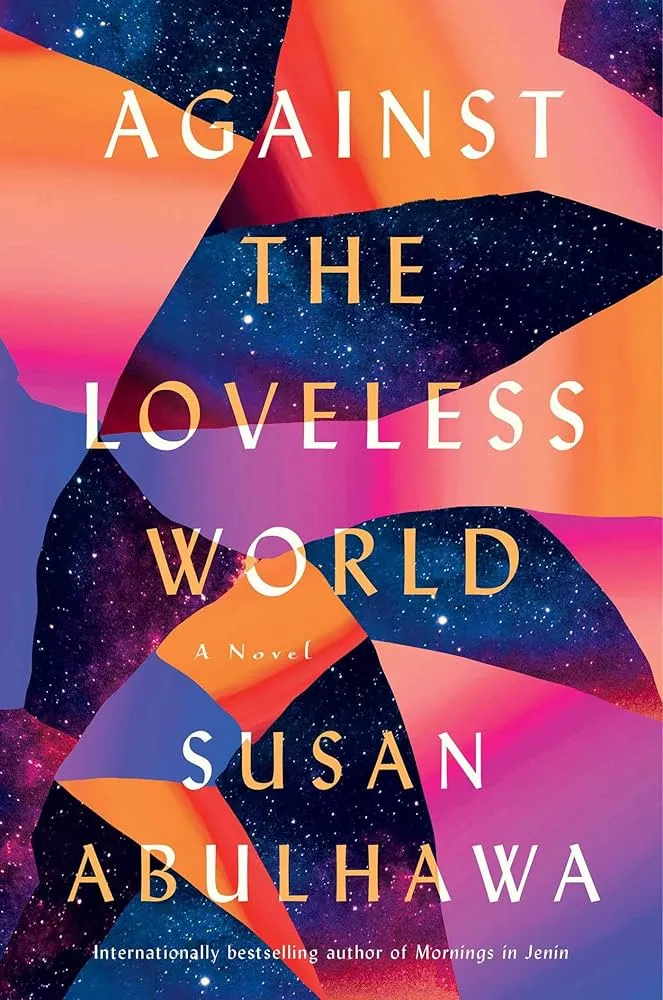
My 10 highlights
-
I indulge an illicit fantasy of a world that would have allowed us to simply live, raise children, hold jobs, move freely on earth, and grow old together. I allow myself to imagine that the dignities of home and freedom might be the purview of the wretched of this earth.
-
I wanted to describe to him how the emotional intimacy growing between us was shattering my heart in the most life-affirming ways, but I didn’t have the right words, except to say that I loved him, which wasn’t nearly enough.
-
Until I met Um Buraq, it had never occurred to me that patriarchy was anything but the natural order of life. She was the first woman I met who truly hated men. She said it openly and without apology. I found her persuasive.
-
Mansaf was always a dish for large gatherings or holidays in my youth. Eating it by hand makes it all the more cherished. The continuity of these traditions helped bridge the spaces between dislocation and the home I had forged in my birthright homeland, but I knew I could never again be complete in one place. This was what it meant to be exiled and disinherited—to straddle closed borders, never whole anywhere. To remain in one place meant tearing one’s limbs from another. I missed my mother. My brother and grandmother. I balled a bite of mansaf in my hand and looked around the room. Bilal, Jumana, Samer, Wadee and Faisal, other friends, Hajjeh Um Mhammad and her sisters, neighbors, and more family. This was where I belonged, but so much of me was still scattered elsewhere.
-
“I respect and accept your wishes, Nahr. You already told me and don’t have to tell me twice. What I wanted to say then is that only we will determine how our relationship should be. We can be whatever we want to each other. We don’t have to make love now, and maybe never, as long as it’s what we desire. All I ask is honesty. I will give you the same, and I will always work to earn and keep your love, respect, and loyalty,” he said.
-
I closed my eyes as our lips found each other. I would like to tell you that I was swept away with passion, but it was not so. The disquiet deep within me, an insecurity or fear so constant I barely knew it was there, arose. As our kiss deepened, became more expressive, thirstier, I was overcome by a desire to weep. No one had ever kissed me with such love, and it occurred to me that happiness can reach such depths that it becomes something akin to grief.
-
Those weeks cloistered together in the house, alone, unable to leave or receive guests, having to sneak into the garden for fresh air and a bit of food, were perhaps the most profound honeymoon anyone could ask for. We packed a few years into a couple of months. We roamed inside each other—our memories, insecurities, and dreams. We explored each other’s bodies, inching toward an enchanted precipice that was both frightening and irresistible.
-
In the end, the planning, risks, fear, and backbreaking work we’d undertaken had been for two useful rifles, one 9 mm pistol, and plenty of ammunition from a Russian-Israeli gangster and a Palestinian dope smuggler. Bilal had spent nearly all his savings to acquire what turned out to be a predominantly useless cache of Cold War–era Russian and American small weaponry. There was nothing we could do about it. Although Bilal and Ghassan were angry initially at having been cheated, by the time we all met again their outlook had changed to optimism. I suppose that’s what made them revolutionaries. They were all-in, with everything they had, and that meant rummaging through defeat and disappointment to find a new plan and cause for hope.
-
“You know, I always had a bad feeling about that no-good dog you married,” she said. My grandmother had a knack for revisionist history. Back then she’d said he was too good for me and urged me to accept his proposal to make an honest woman of me. She had told my mother she’d better marry me off before I let someone puncture my hymen and destroy my reputation. She’d said I was already too old and the marriage window would soon be closing. But not now. “I’m glad you got rid of him,” she said.
-
“The way you live your life in our culture, without apology or shame, even if with sadness, makes you extraordinary and special, Nahr. You, more than any of us, are a revolutionary, and the irony is that you don’t even see it,” he said. The real irony, I thought, was that it was only in that moment with him, when I was truly seen and valued, that I did not feel shame.